When the systems meant to protect children fail, how far would one person go to help?
When Rachel built her soundproof garden shed and moved her piano inside, she never expected the little building to become a sanctuary for children hiding from their parents. But then Rachel isn’t your garden-variety social worker, nor is her shed quite what it seems. With some help from a professor who fails miserably at political correctness, a New Age mom with unconventional ideas about placentas, and three carpenters who look like prophets, Rachel reinvents herself as a Pied Piper with a purpose, discovering that small acts of resistance can make a big difference to her own life and the lives of those she loves.
In this satirical, magical look at why helpers can be less than helpful and abused children much safer on their own than in care, garden sheds grow as big as they need to grow, delinquents are surprisingly well-behaved, and social workers can become heroes as long as they are willing to break all the rules.
The Author Behind the Story
Michael Ungar, Ph.D. is an award-winning author, researcher, and internationally recognized expert on resilience. Across 18 works of fiction and non-fiction, his writing explores the complex ways children, families, and the professionals who support them navigate adversity, hope, and healing.
His first novel, The Social Worker (2011), introduced readers to his unique ability to blend compelling storytelling with the ethical and emotional realities of social work. Orphans in the Garden continues that tradition, inviting readers into a thought-provoking story about compassion, resilience, and the choices we make to protect those who are most vulnerable.
In addition to his writing, Dr. Ungar is a distinguished scholar whose contributions to research and practice have earned numerous honours, including the Canadian Association of Social Workers’ National Distinguished Service Award. He is also a Fellow of the Royal Society of Canada.
Through both his fiction and academic work, Michael Ungar challenges readers to think differently about resilience, community, and what it truly means to care for one another. His blog, Nurturing Resilience, is published by Psychology Today.
Please complete the order form below and submit. Once received, or team will get back to you shortly with a quote including the shipping fee.
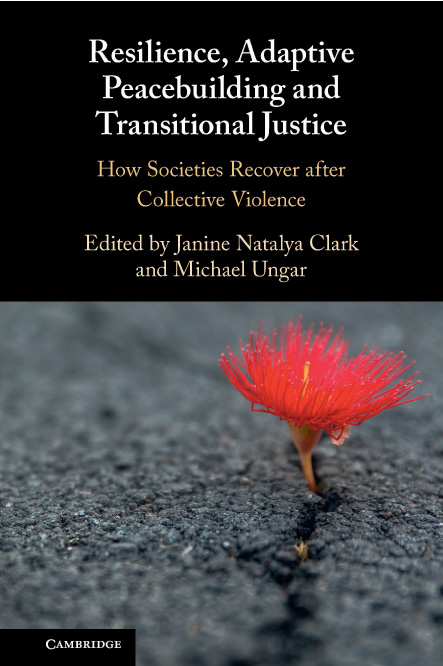
Resilience, Adaptive Peacebuilding and Transitional Justice (2021)
Processes of post-war reconstruction, peacebuilding and reconciliation are partly about fostering stability and adaptive capacity across different social systems. Nevertheless, these processes have seldom been expressly discussed within a resilience framework. Similarly, although the goals of transitional justice – among them (re)establishing the rule of law, delivering justice and aiding reconciliation – implicitly encompass a resilience element, transitional justice has not been explicitly theorised as a process for building resilience in communities and societies that have suffered large-scale violence and human rights violations. The chapters in this unique volume theoretically and empirically explore the concept of resilience in diverse societies that have experienced mass violence and human rights abuses. They analyse the extent to which transitional justice processes have – and can – contribute to resilience and how, in so doing, they can foster adaptive peacebuilding. This book is available as Open Access.